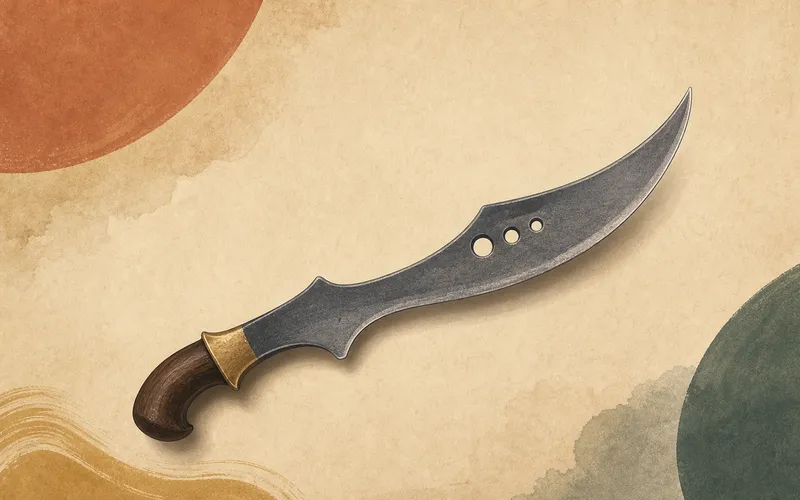
A kujang is a distinctive asymmetrical blade associated with Sundanese culture in West Java. Its curved outline, projecting points, and, on some examples, small holes distinguish it from a straight knife. It is discussed as a tool, weapon, heirloom, and ceremonial object; today its outline is also a familiar regional emblem.
Those roles should not be collapsed into a single origin story. A dated text can document a name or use, while a provincial emblem documents modern public symbolism. Neither proves that every surviving kujang has an ancient date or an identical sacred meaning.
Sundanese Association and West Java Context
Indonesia's cultural heritage directorate identifies the kujang with West Java and Sundanese heritage. It also discusses practical and heirloom interpretations. This regional association is a sound starting point; it does not mean every West Javanese community used the blade in the same way. Directorate of Cultural Heritage and Diplomacy.
The kujang belongs beside other regional objects in Weapons and Regalia. Compare its outline and uses with the keris, while keeping the different traditions distinct.
Distinctive Form and Visual Memory
The kujang is visually memorable because its profile does not reduce easily to a simple dagger or utility knife. Many examples have an asymmetrical curve, a pronounced belly, and a pointed extension that gives the blade a sculptural presence even when it is not richly decorated. This distinctive outline helps explain why the kujang works so effectively as an emblem. A symbol must be recognizable at a glance, and the kujang's silhouette is difficult to mistake for another Indonesian blade.
Scholars and cultural commentators have paid close attention to the relationship between form and meaning in the kujang. Modern studies of Sundanese kujang symbolism often read the blade through categories of local philosophy, social order, and inherited teaching. Museums should treat such interpretations carefully. They reveal how communities and writers make sense of the object, even when they do not always prove the original intention of every historical maker. The form becomes a visual memory bank, open to repeated explanation.
Weapon, Tool, and Heirloom
Calling the kujang a weapon is not wrong, but it is incomplete. Like many Indonesian blades, it stands at the intersection of utility, status, and belief. Some traditions connect the kujang to agricultural or practical tools, while others emphasize its martial or sacred character. The safest reading is not to force these roles into a single origin story, but to recognize that the object has been understood through several overlapping functions.
This overlap is common in museum collections of Indonesian arms. A blade may begin as something that can cut, protect, or threaten, yet later become an heirloom or emblem. Its value then depends on more than its effectiveness in use. The kujang's importance lies partly in the way it condenses many roles at once: blade, craft object, sign of Sundanese identity, and object of remembered authority. That density is precisely why it remains compelling.
Emblem of West Java
One of the clearest modern facts about the kujang is its emblematic role in West Java. The provincial identity of Jawa Barat frequently uses the kujang as a visual marker, and the weapon appears at the center of the province's official symbolism. In this setting the kujang no longer functions as an object to be held in the hand. It becomes a public sign, reproduced in civic design to stand for the region itself.
The provincial government's explanation specifically assigns the five holes in the kujang on its emblem to the five principles of Pancasila. That is documented civic symbolism of the emblem, not evidence that every historic blade had five holes or the same meaning. West Java: emblem and motto.
Textual Evidence, Pajajaran Memory and Uncertain Origins
The cultural heritage directorate refers to Sanghyang Siksa Kanda Ng Karesian, dated 1518, in discussing the kujang's practical associations. This is a textual reference reported by that institution, not an archaeological date for the first kujang or for an unprovenanced museum blade. Indonesian cultural heritage account.
Associations with Pajajaran and Prabu Siliwangi belong to regional historical memory and oral tradition unless a particular claim has independent documentary support. The same caution applies to exact invention dates, sacred geometry, and explanations assigning a fixed meaning to every curve or hole. A modern symbolic reading can be culturally important without establishing a maker's original intention.
Saifulhayat's 2018 study interprets the kujang through Sundanese philosophical teachings. It is useful as an explicitly interpretive study, not a substitute for excavation context, a dated inscription, or a documented object history. ARTic: Study of Forms and Symbols of Sundanese Kujang.
Craft, Knowledge, and Local Interpretation
The kujang also invites attention to makers. Even when a blade is read symbolically, it remains a crafted object of metal, proportion, and surface. Its authority depends on skilled hands that knew how to shape a recognizable form. The outline, holes, curves, handle, and sheath all affect how the object is perceived. In that sense, craft is not merely technical. It is the material language through which cultural meaning becomes visible.
Modern kujang makers and collectors continue this process of interpretation. Some produce blades for display, ceremony, martial arts, or regional commemoration rather than for practical fighting. This continuity does not mean that every new kujang repeats an ancient design without change. It means that the form remains active. Each new object participates in a living conversation about what Sundanese heritage should look like, how it should be taught, and how it should be preserved.
Reading the Kujang in a Museum
For museum visitors, the most useful question is not only "What was it used for?" but "What worlds did it connect?" A kujang connects the material world of blade making with the social world of Sundanese identity. It connects regional history with modern provincial symbolism. It connects documented cultural facts with memories that are meaningful even when they cannot be reduced to archive citations.
This approach also protects the object from two common mistakes. The first is romantic exaggeration, in which every curve is treated as proof of an ancient secret. The second is flat classification, in which the kujang becomes only a weapon type. A richer interpretation places it between those extremes. It recognizes the blade as a real object, made and used in history, while also explaining why later generations turned it into an emblem of belonging.
Conclusion
The Sundanese kujang matters because it is compact but expansive. In a single blade form, it gathers questions of region, craft, status, legend, and civic identity. Its association with West Java and Sundanese culture is secure; many more detailed interpretations belong to the ongoing work of memory and scholarship. That distinction is not a weakness. It is what makes the kujang historically interesting.
Seen in a museum setting, the kujang should be read as both weapon and cultural sign. It reminds us that objects survive not only because they were useful, but because people continued to recognize themselves in them. For West Java, the kujang has become one of those enduring forms: a blade whose sharpest edge may now be its power to carry memory.
For the regional setting, read Sunda and Galuh in historical memory, browse Java, and compare the archipelago's weapon traditions.