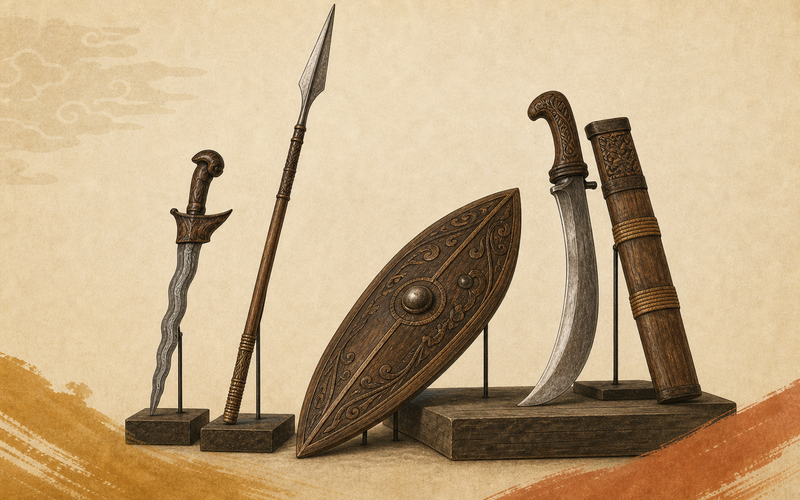
Indonesian weapons belong to a long history in which violence, authority, artistry, and memory often overlap. In a museum case, a blade may first appear to be evidence of combat. Yet many weapons from the archipelago were also social signs, ritual objects, diplomatic gifts, and inherited treasures. Their meanings changed over time as political systems shifted from regional kingdoms and courts to colonial administrations and modern nationhood.
This historical movement matters because it helps explain why traditional weapons remain culturally powerful even when their military role has faded. A keris, rencong, badik, mandau, or kujang should not be reduced to a single category. Some were tied more closely to fighting, some to court display, and some to inherited prestige. Taken together, however, they show how objects once associated with warfare could later become carriers of identity and heritage.
Weapons in the World of Kingdoms
Before colonial rule, weapons in the Indonesian archipelago belonged to highly varied political landscapes. Regional polities, maritime states, and inland courts all depended on martial organization, but they did not produce a single uniform weapon culture. Blades were shaped by local resources, metallurgical knowledge, and ideas of rank. Museum records for objects such as the badik and mandau, and cultural documentation around the rencong, make that regional variety more concrete. In that context, a weapon could be practical and symbolic at the same time. It was something to carry into conflict, but also something that marked affiliation, masculinity, office, or noble authority.
The keris became especially prominent in parts of Java and the wider Malay world, where it was valued not only for use but also for form, pamor patterning, and attributed origin. Britannica notes its long-standing reputation as a distinctive asymmetrical dagger, while Indonesian cultural authorities describe its development through changing social functions. For museum interpretation, that combination is crucial. It shows that even in earlier periods, the line between weapon and culturally charged object was already becoming porous.
Court Culture and the Language of Rank
As courtly life became more elaborate, certain weapons entered systems of etiquette and regalia. They were worn with formal dress, presented in political settings, and judged through conventions of refinement. The significance of the weapon therefore extended beyond its effectiveness in battle. Placement on the body, decoration of the hilt and sheath, and association with specific workshops or lineages all helped communicate standing. A blade could tell viewers something about office, allegiance, and legitimacy before it was ever drawn.
The keris is the clearest example because official Indonesian heritage documentation describes a historical shift from weapon to sacred heirloom, family symbol, sign of service, sign of rank, and admired art object. That sequence does not mean warfare disappeared from the story. Rather, it means that in many settings the social life of the weapon became broader than combat. Museums can use this point to explain why traditional weapons belong to histories of ceremony and governance as much as to histories of fighting.
Spiritual Meaning and Heirloom Status
Weapons also entered domains of belief. UNESCO describes the Indonesian kris as both a weapon and a spiritual object, and that phrasing is unusually direct. It reminds us that some blades were understood through systems of moral and cosmological meaning, not merely as tools of force. In many Indonesian contexts, the keris could be discussed as pusaka, an heirloom whose value rested in genealogy, reputation, and attributed power. Such beliefs were not identical everywhere, and not every blade was treated alike, but the broader pattern is well documented.
This heirloom dimension helps explain why preservation practices could involve reverence as well as maintenance. A weapon transmitted across generations was not simply old metal. It embodied family memory, obligation, and inherited prestige. For museums, this creates an interpretive challenge. If a keris is displayed only as an ethnographic specimen or technical blade, much of its historical meaning is lost. The object becomes more legible when visitors understand that it might once have acted within a living network of ancestors, ritual care, and social identity.
Colonial Collecting and the Reframing of Weapons
During the colonial period, many Indonesian weapons entered new systems of classification and exchange. They circulated as gifts, trophies, collectibles, and museum objects. This was not a neutral process. Colonial collecting often detached an object from the ceremonial, familial, or regional worlds that had given it meaning. Once catalogued in a European collection, a weapon might be presented mainly as an exotic arm, a sign of native custom, or an example of decorative craftsmanship.
At the same time, museum records from that period preserve evidence of how these weapons were understood. Rijksmuseum describes one luxurious kris presented to Governor-General J. C. Baud in 1834 as a suitable diplomatic gift because it symbolized power and offered protection from evil. That description is historically valuable because it captures both political and spiritual language in a colonial collection context. It also shows that weapons did not stop carrying local meanings when they entered imperial circuits. Those meanings were instead translated, reduced, or selectively recorded.
From Artifact to National Heritage
In the modern period, traditional weapons increasingly came to be treated as heritage rather than as practical arms. UNESCO's inscription of the Indonesian kris as intangible cultural heritage is particularly important because it recognizes not only the object but also the knowledge attached to it. The focus shifts toward makers, classifications, decorative systems, terminology, maintenance, and transmission. In other words, heritage work does not preserve a blade alone. It preserves a cultural field.
That change also reflects the priorities of postcolonial museums and cultural institutions. Weapons can now be interpreted as part of Indonesian artistic and historical identity, not only as remnants of conflict. This does not erase their martial past. Instead, it situates that past within a longer trajectory that includes ceremonial dress, diplomacy, court culture, and contemporary safeguarding. The most responsible reading therefore resists both romanticism and simplification. These objects were never only weapons, but they were also never outside history.
Why Museum Context Matters
For museums, the historical journey from warfare to cultural heritage should shape how Indonesian weapons are displayed. A case arranged only by blade type or regional label may be useful, but it is incomplete. Visitors also need context about who made the object, who wore it, what social role it played, and how its meaning changed over time. A blade associated with a court dignitary, a village lineage, or a colonial collection does not tell the same story, even when the material form appears similar.
This wider framing also protects against flattening the diversity of the archipelago. Acehnese, Bugis, Javanese, Balinese, and Dayak weapon traditions developed in different environments and cannot be collapsed into a single national template. Yet a historical comparison remains valuable when it is handled carefully. Across those differences, Indonesian weapons reveal a recurring pattern in which objects of force could become objects of memory, status, and cultural care. That is one of the main reasons they continue to matter in museum collections today.
Conclusion
Indonesian weapons through history show how material culture can move across political and symbolic worlds. What began in many cases as an implement of warfare could later function as regalia, heirloom, diplomatic language, collectible, and protected heritage. The keris stands at the center of this history because its documentary record is especially rich, but it also points toward broader transformations across the archipelago.
To study these weapons in museums is therefore to study change over time. Blades were forged for conflict, worn in courts, guarded within families, reclassified in colonial collections, and preserved within modern heritage institutions. That layered passage from warfare to cultural heritage is not a side story. It is one of the clearest reasons these objects remain historically and culturally significant.