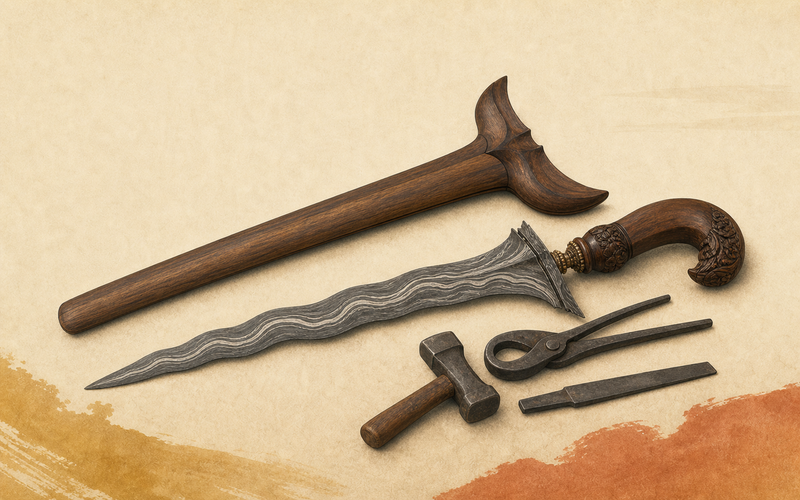
The keris occupies a special place in Indonesian material culture because it does not sit comfortably inside a single category. It is often introduced as a dagger or weapon, yet cultural institutions describe it in broader terms that include artistry, lineage, rank, and spiritual force. A museum visitor looking at one keris may therefore be seeing more than an edged object. The blade can also be evidence of how Indonesian communities invested metalwork with social memory and inherited meaning.
That layered identity makes the keris especially valuable for museum interpretation. It shows how one object can move across different social worlds without losing its recognizability. A keris might be worn, inherited, exchanged, cared for, displayed, or feared for reasons that were not identical but still connected. Studying those shifts helps explain why the keris remains one of the clearest examples of an Indonesian object that is practical, symbolic, and sacred at the same time.
The Keris as a Weapon
Any responsible account should begin by admitting that the keris is, in part, a weapon. Its blade form, asymmetry, and association with the body make that impossible to ignore. Historical writing and general reference works identify it as a dagger, and that description is not wrong. The keris belonged to worlds in which edged weapons could matter for self-defense, conflict, and visible masculinity. To deny that would flatten the object just as much as reducing it to combat alone.
At the same time, the category of weapon does not explain everything that historical sources say about the keris. The blade was never important only because it could injure. Its shape, pamor patterning, sheath, and hilt all matter in ways that go beyond utility. Museums therefore have to hold two truths together: the keris emerged from martial culture, yet it also became meaningful through settings where physical force was not the main point. That tension is the beginning of its historical richness.
From Blade to Heirloom
One of the most important changes in the social life of the keris occurs when it becomes pusaka, or heirloom. UNESCO notes that heirloom keris are passed from one generation to another, and that fact immediately changes the way the object should be read. A family inheritance is not simply an old possession that survived by chance. It becomes a material sign of continuity, kinship, and obligation. The blade remains the same object, but its value now rests partly in the chain of people who kept it.
This inherited status helps explain why discussions of the keris often use language of stewardship rather than ownership alone. A keris received from ancestors may bring responsibilities as well as prestige. It can stand for family dignity, remembered service, or a relationship to forebears that should be maintained rather than consumed. In museum terms, this is crucial. Once a keris has heirloom status, it cannot be interpreted only through metallurgy or typology. Its biography becomes part of the object itself.
Sacred Meaning and Attributed Power
The keris is also notable because official heritage sources are unusually direct in describing its sacred or spiritual dimensions. UNESCO refers to the Indonesian kris as both a weapon and a spiritual object, while Indonesian cultural writing also places it within worlds of offering, reverence, and inherited force. This does not mean that every keris everywhere was treated in the same sacred manner. It does mean that the documentary record consistently warns against reading the object as spiritually neutral.
For museums, attributed power is not an embarrassment to be edited out. It is part of the historical record. People did not value some keris only for beauty or antiquity, but also for the qualities they believed the blade might carry or mediate. Such qualities cannot be measured like length or metal composition, yet they still shaped how the object was stored, transmitted, and approached. A museum label that ignores this dimension may appear cautious, but it also risks becoming incomplete.
Craftsmanship, Pamor, and the Authority of the Empu
The sacred and heirloom status of the keris depends in part on craftsmanship. Heritage sources repeatedly emphasize the role of the empu, the specialist maker whose expertise combines technical skill, aesthetic judgment, and knowledge of established forms. The keris is not a generic blade that happened to collect meaning afterward. Its making already involves a cultural system in which blade shape, pamor patterns, and mounting can signal value, age, reputation, and intended use.
This is one reason museum interpretation should not separate spiritual meaning from material form. The object's aura is tied to the visible evidence of craft. A blade that shows careful forging and distinctive patterning does not merely look refined; it demonstrates that the keris belonged to a world where technical excellence and symbolic readability reinforced one another. The maker's authority matters because the object begins its cultural life in the workshop, where form and meaning are joined.
Rank, Dress, and Public Representation
The keris also moved through public and ceremonial life. Indonesian heritage documentation describes it as a sign of rank, a part of dress, and a mark of service. In these settings the keris functioned less as a hidden instrument and more as visible social language. To wear one in a courtly or formal context was to say something about status, legitimacy, and belonging. The object helped make hierarchy legible. This is another reason why the keris cannot be handled as a simple knife with a decorated sheath.
Museum collections preserve traces of this public role. The Rijksmuseum record for the kris presented to Governor-General J. C. Baud in 1834 is especially telling because it describes the object as a diplomatic gift associated with power and protection. That example shows that the keris could travel into political exchange without shedding its symbolic force. Even when it entered colonial collecting networks, the object carried meanings rooted in authority, ceremony, and social representation.
Why Museums Must Read It Broadly
If a museum presents the keris only as a weapon, it narrows the object too quickly. If it presents it only as art, it risks detaching the blade from histories of power, masculinity, and violence. If it presents it only as a sacred relic, it may imply a false uniformity that the sources do not support. The best interpretation is therefore a broad one that allows several registers to remain visible at once. The keris is best understood as an object whose meanings overlap rather than replace one another.
This broad reading also helps visitors understand why the keris remains such a powerful case in discussions of Indonesian heritage. It condenses workshop knowledge, inherited memory, social rank, and systems of belief into one portable form. That complexity is precisely what makes museum treatment difficult and worthwhile. The keris asks curators to explain not just what an object is made of, but what kinds of life it entered and what kinds of value communities attached to it over time.
Conclusion
The keris matters because it reveals how a single Indonesian object can inhabit several cultural roles at once. It is a weapon in origin and form, but it is also an heirloom that carries family continuity and a sacred object that may hold attributed power. Its significance grows further through craftsmanship, ceremonial display, and diplomatic exchange.
For museums, the keris therefore offers a lesson in interpretive balance. It should be shown neither as a mere blade nor as an abstract symbol detached from history. When read through use, inheritance, belief, and making together, the keris becomes one of the clearest museum objects for understanding how material culture in Indonesia gathers power across generations.