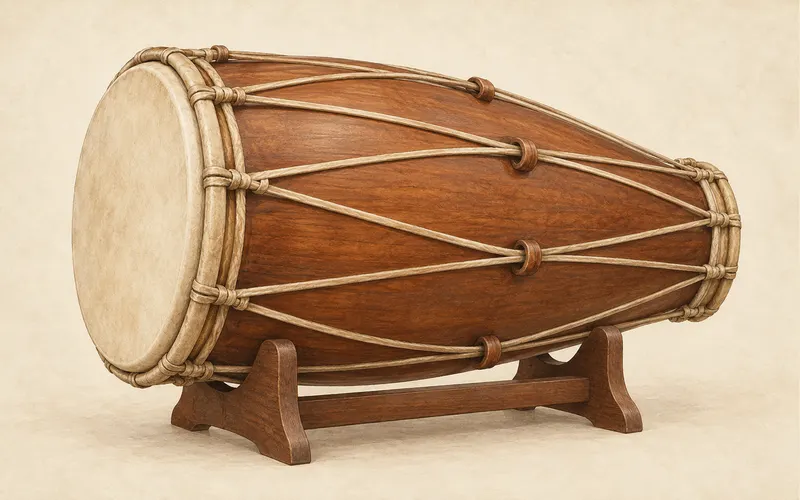
Kendang are drums used in Indonesian ensemble music, including the gamelan traditions of Java and Bali. In Central Java, the spelling kendhang is also common. Sri Hendarto’s study of Yogyakarta instruments calls the kendang lurah gending, the leader of the musical piece: an instrument whose sounds guide the ensemble. This article begins with Central Javanese forms, then considers named Sundanese and Balinese practices. Hendarto, 1992.
For the ensemble setting, see gamelan instruments and cultural roles and the Music and Dance collection.
Two heads, a wooden shell, and adjustable lacing
A Javanese kendhang ageng has two hide heads of unequal size attached to a wooden shell. Its body tapers, with a slight bulge toward the wider end. Laces connect the heads along the shell; sliding rings around paired laces adjust their tension and pitch. The drum lies horizontally on a stand and is played with the hands. These visible features make the relationship between construction and sound particularly clear. Vetter: kendhang ageng/gendhing.
A palace example may carry carving and paint coordinated with its gamelan set. Decoration can therefore identify membership in an ensemble as well as furnish an individual object. A plain illustration, such as the one accompanying this article, instead emphasizes the drum’s general construction. Vetter’s Yogyakarta inventory.
Ageng, ketipung, and ciblon
The large drum is called kendhang ageng or gendhing. A smaller kendhang ketipung can be played with it, forming the pairing called kendhang loro or kalih, meaning two drums. Vetter’s Yogyakarta inventory describes the ketipung as a two-headed, hand-played drum with sliding tension rings, resting horizontally on a stand. Its place beside the larger drum shows why a museum display needs to explain combinations as well as individual instruments. Vetter: ketipung.
Kendhang ciblon, also called batangan, has a particularly close relationship with dance. Its patterns accentuate movements while guiding the accompanying music’s tempo. The player needs knowledge of choreographies and repertory alongside control of contrasting strokes. Vetter explains ciblon as playfully striking water with open or cupped palms, an activity often cited as inspiration for the drumming style. Grinnell: ciblon.
Leadership heard through drum patterns
In Central Javanese performance, leadership is audible. The kendhang player’s patterns relate to the phrase structure of a gendhing, and the sounds themselves guide changes of tempo. Knowing when and how to make those changes requires familiarity with the ensemble’s repertory. Prasetyo: kendang leadership.
This offers a useful listening question: when the music changes pace, what did the drummer play immediately beforehand? Compare that function with the bonang’s melodic elaboration. Listening across these parts reveals how musicians coordinate a performance.
Sundanese creation and Balinese coordination
In West Java, kendang also belongs to histories of individual creativity. Asep Saepudin’s 2013 book examines Suwanda’s creation of tepak kendang Jaipongan in the 1980s, tracing a named musician’s contribution to Sundanese performance. It offers a specific modern history rather than an anonymous account of inherited rhythms. For another Sundanese performance setting, see wayang golek in West Java. Saepudin, 2013.
For Balinese gong kebyar, I Putu Danika Pryatna and Hendra Santosa identify the drummer’s work as managing dynamics and tempo and initiating and ending pieces. Their qualitative study describes communication through body language, drum patterns, and changes in loudness. Leadership thus involves physical cues as well as sound. These findings concern gong kebyar; the comparison of Javanese and Balinese gamelan provides a broader regional frame. Pryatna and Santosa, 2020.
Historical evidence and museum listening
Double-headed hand drums appear in ninth-century Borobudur reliefs, but Vetter distinguishes their shapes from modern kendhang. The reliefs document earlier drumming, while the precise origin of today’s instrument remains uncertain. Grinnell: historical discussion.
Grinnell’s gendhing and ciblon records include audio demonstrations. Paired with a view of the lacing and heads, such recordings let visitors connect an object’s construction to the changing sounds that guide other performers. The kendang becomes understandable as both a crafted instrument and a means of collective musical action.