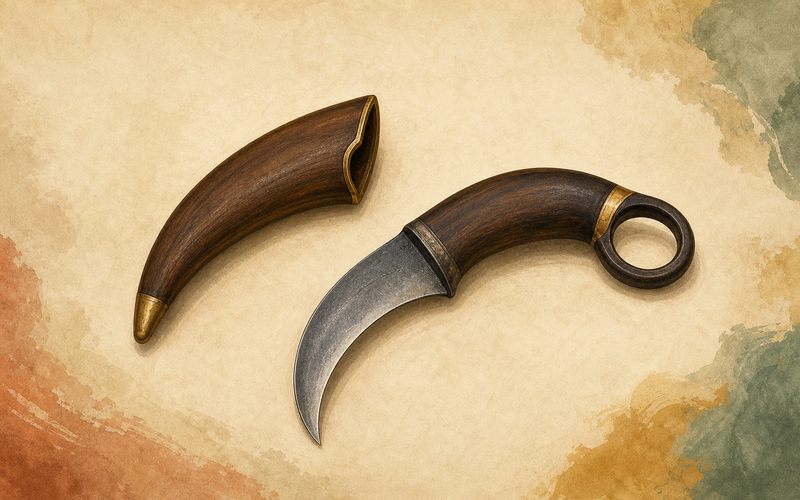
The kerambit, often spelled karambit in English-language writing, is one of the most immediately recognizable blades associated with Indonesia. Small, curved, and often fitted with a ring at the handle, it looks different from the long sword, the court dagger, or the farming machete. Its profile suggests a claw, hook, or crescent, and that shape has made it powerful in both martial imagination and museum display.
For a museum audience, the kerambit is most useful when it is placed in the social world of West Sumatra and the Minangkabau people. Britannica identifies the Minangkabau as a major Sumatran people whose homeland lies in the west-central highlands, with traditions of metalworking, weaving, wood carving, matrilineal kinship, and migration. In that setting, a blade is never just a blade. It belongs to craft, household economy, self-defense, performance, and regional memory.
A Minangkabau Blade in a Sumatran Landscape
The kerambit is widely associated with Minangkabau communities of West Sumatra. Indonesian and regional names vary, including kerambit, karambit, kurambik, and karambiak, and those variations already tell us that the object moved through languages and local practice. A museum label should therefore avoid treating one spelling as the only authentic form. The more important point is the blade's strong association with a Minangkabau cultural field.
West Sumatra's landscape helps explain why compact tools and portable heirlooms mattered. Minangkabau life historically joined irrigated agriculture, highland settlement, village institutions, Islamic learning, and the practice of merantau, or leaving the homeland to seek experience and opportunity elsewhere. A small blade could belong to that mobile world more easily than a heavy weapon. It could be carried, concealed, stored, repaired, and remembered.
Shape, Grip, and Visual Recognition
The kerambit's most distinctive feature is its inward-curving blade. Many examples are short enough to sit close to the hand, while the handle ring can help secure the grip. In modern martial language the ring is often discussed as a way to prevent disarming or to allow hand movement, but museum interpretation should keep such claims proportional. The physical design clearly encourages a close, hooking, or slashing motion; exactly how each example was used depends on period, maker, and training context.
Its shape also gives the kerambit symbolic force. Longer Indonesian blades such as the keris, pedang, mandau, badik, and rencong can carry status through length, decoration, pamor patterning, or sheath design. The kerambit works differently. Its authority comes from compactness and silhouette. Even a plain example can be memorable because the curve is so concentrated. This makes it an object that visitors can recognize quickly while still needing careful explanation.
Tool, Weapon, and the Question of Origin
Many accounts connect the kerambit with agricultural tools, especially sickle-like implements used in cutting, gathering, or fieldwork. This is plausible in a broad Southeast Asian context, where agricultural tools and weapons often overlap in form. A curved blade can cut plants, rope, fiber, and other materials; in another setting, the same logic of the curve can become martial. The difficulty is that a plausible functional story is not the same as a fully documented origin.
Origin legends often compare the kerambit to a tiger's claw. In West Sumatran and Minangkabau imagination, the tiger has strong associations with strength, danger, and alertness, and the comparison helps people remember the blade's curved form. A museum can include this imagery without turning it into a literal engineering record. It is safest to say that the claw comparison is a powerful cultural explanation, while the historical development of the blade probably involved craft practice, utility needs, and martial adaptation over time.
Silek and Martial Context
The kerambit is closely connected in modern public knowledge with pencak silat, Indonesia's broad family of martial traditions. UNESCO recognizes the traditions of pencak silat as intangible cultural heritage, emphasizing that they include physical technique, mental discipline, cultural values, and artistic elements. In West Sumatra, the local term silek is often used, and Minangkabau martial traditions are frequently discussed as part of regional identity.
Within this context, the kerambit is not simply a dangerous object. It is part of a disciplined body culture: stance, timing, distance, restraint, and transmission from teacher to student. Demonstrations may dramatize the weapon's speed or curved motion, but the deeper museum question is how a community trains bodies to carry memory. A blade used in silek connects metalwork to movement, and movement to ideas about alertness, honor, and self-command.
Curved Blades Across the Archipelago
The kerambit belongs to a wider Indonesian world of curved and regionally distinctive blades. The archipelago contains many blade traditions, from the ceremonial and cosmological language of the keris to the social meanings of the Acehnese rencong, the Dayak mandau, the Bugis and Makassar badik, and the Sundanese kujang. Each type has its own geography, handling, and symbolic field. Their differences warn against flattening Indonesian weapons into a single national style.
Curvature itself does not always mean the same thing. A sickle-like blade may speak to farming. A hooked blade may be useful in close grappling or cutting. A wavy or asymmetrical blade may carry courtly, spiritual, or aesthetic meaning. The kerambit's curve should be read through its local setting rather than through a universal theory of sharp objects. Its West Sumatran association gives the form a social address.
Craft, Materials, and Heirloom Value
The kerambit also invites attention to makers. Even when the blade is undecorated, it requires decisions about metal, heat, thickness, edge, handle angle, ring size, and sheath. Some handles are described in wood, horn, or other durable materials, and these choices affect both use and display. The maker's skill lies not only in producing sharpness, but in balancing a compact object so that it feels coherent in the hand.
In many Indonesian communities, weapons can become heirlooms, gifts, or objects of memory after their practical use has faded. A kerambit kept in a family or collected as regional material culture may no longer be used for cutting or martial training. Its value may instead lie in origin, maker, lineage, or the stories attached to it. This shift from tool to heirloom is not a loss of meaning. It is one way objects survive.
Modern Visibility and Museum Responsibility
The kerambit has become internationally visible through martial arts, film, tactical knife design, and online self-defense culture. That visibility brings new audiences, but it can also distort the object. Modern folding karambits, fantasy designs, and commercial claims often enlarge or dramatize the blade far beyond its older regional contexts. A museum should acknowledge modern popularity while guiding visitors back toward West Sumatra, Minangkabau craft, and Indonesian martial heritage.
Responsible interpretation also avoids making the kerambit only exotic or violent. Its sharpness matters, but so do its scale, portability, regional naming, and place among other Indonesian blades. The object can teach visitors how material culture travels: from field tool or close weapon, to martial emblem, to collectible, to global design inspiration. Each stage adds meaning, but not every added meaning has the same historical weight.
Conclusion
The Minangkabau kerambit matters because it gathers large questions into a small form. Its curve suggests utility, danger, movement, and memory at once. Its association with West Sumatra places it within a society known for strong adat, matrilineal inheritance, migration, craft, and intellectual mobility. Its role in martial culture links metal to disciplined bodies and local teaching.
Seen carefully, the kerambit is not a simple relic of combat and not merely a modern tactical icon. It is a compact expression of Indonesian regional heritage. A museum reading should keep the blade close to its Minangkabau setting, respect the power of legend without overstating it, and show how a curved piece of metal can carry the weight of place, practice, and identity.