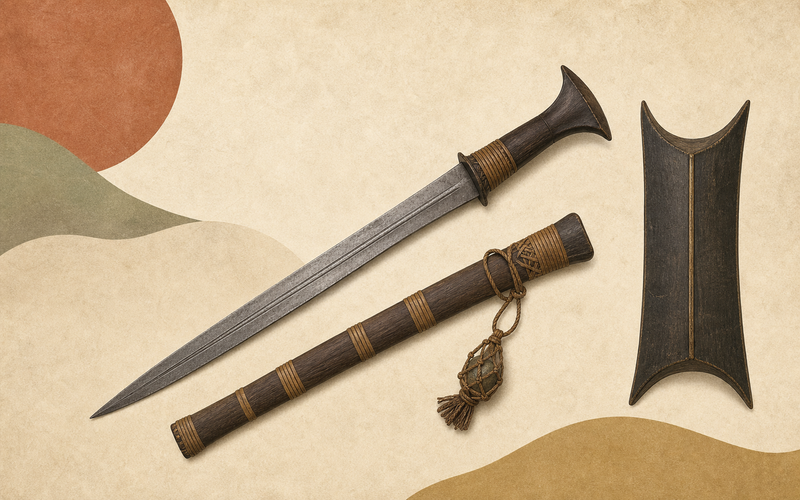
The balatu sword of Nias belongs to a world where martial objects were never only instruments of force. On Nias, an island west of Sumatra with a long history of distinctive village architecture, stone monuments, rank ceremonies, and public performance, weapons could make social identity visible. A sword carried by a warrior or noble figure was not simply a sharpened edge. It could show who had authority, who was expected to protect a community, and how courage was framed by custom.
For museum interpretation, the balatu is especially useful because it brings several fields of Nias culture together. Its blade speaks to combat and defense. Its hilt and scabbard speak to craft and display. Its amulet attachments point toward protective belief. Its appearance beside shields, armor, and war dance memory shows that warrior identity was performed as well as practiced. To understand the object, the viewer has to read the whole assemblage, not just the cutting edge.
Nias as a Martial and Ceremonial Landscape
Nias society is often introduced through stone jumping, megalithic monuments, and impressive timber houses raised on strong posts. These public forms matter because they show that status was built through visible acts. Houses, stones, feasts, and ceremonies made achievement legible within the village. Martial identity worked in a similar way. It depended on skill and courage, but it also needed recognition by the community.
Older accounts describe Nias as a place where inter-village conflict, defense, and warrior display held real importance. Those histories should be handled carefully, because colonial-era writing often exaggerated violence while ignoring local ethics and social order. Still, weapons, shields, armor, and war dances show that martial life did form part of Nias heritage. The balatu belonged to that field of meaning, where protection, rank, and public presence were closely linked.
The Form of the Balatu
The balatu, also encountered in catalogues as balato or related spellings, is generally described as a Nias sword with a single-edged blade. Examples vary in shape, length, hilt treatment, and scabbard decoration. Some blades broaden toward the point, giving the sword a strong visual weight near the end. This form gives the object a distinctive profile even before the viewer studies its fittings.
The hilt and scabbard are central to its meaning. References to Nias swords often note hilts shaped in relation to animal or mythic forms, especially the lasara, a protective figure in Nias visual culture. Scabbards could be bound with rattan or metal, and some included a small rounded container or bundle associated with amulets. These features shift the sword from a simple weapon into an object of protection, display, and identity. The blade may be the most obvious element, but the mounted sword is the cultural object.
Rank, Nobility, and Public Authority
In many Indonesian societies, weapons could become signs of rank, and Nias was no exception. A richly mounted sword did not merely suggest access to metal or skilled craft. It could announce a person's position within a village order. The balatu was therefore tied to authority as much as to fighting ability. It helped make status visible in a way that could be carried, shown, and remembered.
This matters because Nias rank was also expressed through feasts, monuments, and houses. A noble or leading figure did not stand apart from material culture; status was made visible through it. A sword worn or displayed in the right setting could contribute to that public language. It gave the bearer a controlled image of force, one joined to obligation. The important point is not that every sword had the same rank meaning, but that the category could participate in a wider system of honor.
Protection, Amulets, and the Scabbard
The amulet bundle sometimes associated with Nias swords is one of the most revealing details for museums. It reminds viewers that protection was not understood only in physical terms. The sword could defend the body, but its fittings might also suggest unseen forms of danger and care. A scabbard attachment made of rattan, teeth, or other materials could turn the object into a portable gathering of protective signs.
Modern viewers may be tempted to separate practical and spiritual meanings, but the balatu resists that split. A warrior's confidence could depend on technique, community recognition, ancestral memory, and protective belief at once. The scabbard was not a decorative afterthought. It framed the blade and helped define the sword's power. In a museum case, this means the sheath and attachments deserve as much attention as the steel.
Shields, Armor, and Warrior Performance
The balatu is best understood alongside other Nias martial objects. Shields known as baluse, spears, helmets, and armor appear in descriptions and images of Nias warrior culture. In performance contexts, especially war dances, the shield and sword together created a visual grammar of defense and response. The left hand could carry the shield, while the right displayed the weapon. The body became the meeting point of object, rhythm, courage, and communal memory.
Such performances do not simply preserve old combat techniques. They transform martial identity into public heritage. The dance setting allows a community to remember warrior values without reproducing conflict itself. The sword becomes a sign of discipline, readiness, and inherited strength. For visitors, this is an important distinction: a weapon in performance may speak less about violence than about how a society teaches courage, restraint, and belonging.
Changing Meanings Over Time
The meaning of the balatu has not remained frozen. Nias communities have changed through missionization, colonial rule, Indonesian state formation, tourism, migration, and local cultural revival. Practices associated with warfare or older belief systems may no longer carry the same functions they once did. Yet objects can continue to matter because they hold memory. A sword may move from combat equipment to heirloom, from heirloom to performance object, or from local possession to museum collection.
Museums should make that movement visible. A balatu in a collection may have lost part of its biography: the maker, owner, village, ceremony, or route into the market may be unknown. Rather than treating those gaps as silence, interpretation can explain why they matter. The object once belonged to living relations among people, houses, ceremonies, and ideas of protection. Its present still carries traces of those relations, even when the record is incomplete.
Reading the Balatu in a Museum
A careful museum reading begins with the whole object. The blade form can be compared with other Indonesian swords, but the hilt, scabbard, bindings, and attachments localize the balatu within Nias culture. Wear marks, repairs, replaced bindings, and differences in decoration may point to long use or changing ownership. Even when such details cannot be translated into exact history, they help the viewer see the sword as an object with a life.
The balatu also asks museums to avoid narrow categories. It is a weapon, but it is also regalia, protective equipment, craft, performance memory, and a sign of social identity. Its importance lies in the way these meanings overlap. To display it only as an exotic blade would flatten the object. To display it within Nias architecture, rank, dance, and belief restores the world that made the sword legible.
Conclusion
The Nias balatu sword is a compact record of warrior identity. Its sharpened form recalls defense and conflict, but its mounted body points toward rank, protection, performance, and community memory. In Nias culture, martial courage was not only a private skill. It was shaped by public recognition, ritual objects, and the expectations placed on those who carried authority.
For museums, the balatu offers a lesson in responsible interpretation. A sword should not be separated from the village worlds, ceremonies, and beliefs that gave it force. When read through its hilt, scabbard, amulets, dance associations, and rank meanings, the balatu becomes more than a weapon. It becomes a cultural statement about how power was carried, displayed, protected, and remembered.