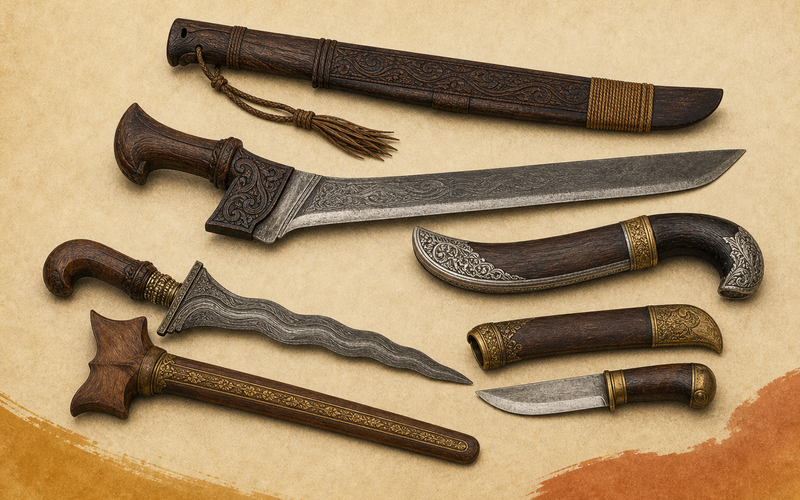
Traditional Indonesian weapons are often introduced as relics of warfare, but that description is too narrow to explain why they still matter in museum collections and public memory. Across the archipelago, blades and edged weapons were tied to local histories of leadership, dress, exchange, and inherited reputation. Some remained strongly associated with combat, while others gathered meanings that reached well beyond practical use. To study them today is therefore to study stories: stories about where an object came from, who was allowed to carry it, what sort of authority it signaled, and why descendants or institutions preserved it.
This broader perspective is especially important in Indonesia, where the label "traditional weapons" covers many regional forms rather than one uniform tradition. Well-known examples include the keris, the rencong of Aceh, the badik associated with parts of Sulawesi, the mandau of Borneo, and the kujang of West Java. These objects do not all share the same history, symbolism, or social role. A careful museum reading should resist turning them into interchangeable examples of exotic arms. What links them more securely is that each can carry local narratives about belonging, power, memory, and craftsmanship.
More Than Tools of Combat
Weapons are practical objects, and it would be misleading to deny their connection to violence, defense, or political force. Yet museum collections regularly show that a weapon's meaning did not end with its ability to wound. In many societies, objects made for conflict also entered the worlds of ceremony, diplomacy, lineage, and artistic display. Indonesian examples fit this broader pattern. A blade could mark adulthood, accompany formal dress, indicate office, or remain in a household as a valued inheritance long after its military usefulness had faded.
That shift in meaning matters because it changes the questions we ask. Instead of asking only how sharp a blade was or how it was used in battle, we begin to ask who commissioned it, how it was worn, and what stories were told about it afterward. Museums benefit from this approach because it lets visitors see weapons as parts of social life rather than as detached instruments. A decorated sheath, a distinctive hilt, or an inherited name may tell us as much as the blade itself.
The Keris as the Clearest Case
Among Indonesian weapons, the keris is the most thoroughly documented example of an object with layered meanings. UNESCO describes the Indonesian kris, or keris, as a characteristic asymmetrical dagger that functions both as a weapon and as a spiritual object. Indonesian heritage authorities also present it not only as a blade but as a cultural emblem shaped by specialized knowledge, regional variation, and long historical transmission. Because the documentary record is richer here than for many other weapons, the keris offers the safest starting point for a broader article about stories attached to Indonesian arms.
Several kinds of stories gather around the keris at once. There is the story of making, centered on the empu, the specialist smith whose technical and artistic knowledge determines the blade's form and surface patterning. There is the story of ownership, in which a keris may become pusaka, an heirloom passed through families or associated with rank and service. There is also the story of attributed power. UNESCO notes that keris are often understood to possess spiritual or magical qualities, which means that the blade has historically been read through systems of belief as well as through metallurgy. These overlapping narratives help explain why the keris cannot be reduced to a weapon type alone.
Regional Weapons, Regional Histories
The keris should not erase the diversity of other Indonesian weapons. The rencong is widely associated with Aceh, the badik with communities in South Sulawesi, the mandau with Dayak contexts in Borneo, and the kujang with Sundanese historical memory in West Java. Even when a museum label gives only a short identification, those regional associations already signal that a weapon belongs to a particular historical landscape. It is tied to local forms of authority, ideas of masculinity or protection, and visual conventions that make it recognizable to the communities that know it.
Not every one of these weapons is documented in the same way. That is why a conservative article should avoid forcing them into a single mythic narrative. Still, it is reasonable to say that they often stand for more than fighting. A rencong may be read within Acehnese memory, a badik within Bugis or Makassarese worlds of honor and self-presentation, and a mandau within discussions of warfare, carving, and Dayak material culture. The stories differ, but the interpretive principle is shared: the weapon becomes a compact carrier of regional identity.
Stories Carried by Craftsmanship
One of the most revealing stories attached to a weapon is the story of how it was made. In museum settings, craftsmanship often provides the bridge between utility and symbolism. The keris is again the clearest example because heritage documentation draws attention to the blade's pamor patterns, the relationship between blade and sheath, and the recognized expertise of the maker. These features show that the object's value was never only functional. Its materials, proportions, and ornament could communicate refinement, genealogy, or cultural legitimacy.
This point also helps us understand why some weapons survive as treasured objects even when their original martial role no longer structures everyday life. A carefully forged or elaborately mounted blade preserves labor, style, and transmitted knowledge. In that sense, the weapon records a workshop tradition as much as a political one. The owner's story and the maker's story are joined together. For museums, this is a useful interpretive move because it shifts attention away from violence alone and toward the human networks that produced and cared for the object.
Rank, Diplomacy, and Public Display
Weapons also acquired stories through public use. Indonesian cultural documentation notes that the keris could become a sign of rank, office, and family prestige, and museum collections support the same point. The Rijksmuseum, for example, identifies one luxurious kris as a diplomatic gift and emphasizes its association with power and protection. Such records show that a blade might function as visible political language. To wear, exchange, or present a weapon in a formal setting was to communicate status and relationship, not simply readiness for combat.
Once we notice this, a wider pattern comes into view. Traditional weapons could move across different social worlds: from battlefield to court, from workshop to household, from personal possession to collected heritage. Their stories changed at each stage. A blade first valued for practical use might later be remembered for the ancestor who carried it, the ruler who bestowed it, or the craft lineage that produced it. The object's physical continuity made it a convenient vessel for changing meanings over time.
Why Museums Preserve Them
Modern museums and cultural institutions preserve Indonesian weapons not only because they are old, but because they condense many layers of history into a single form. A visitor encountering a keris, mandau, or rencong in a display case is not seeing only steel, wood, or ornament. The visitor is seeing a record of regional aesthetics, social hierarchy, inherited memory, and the choices made by collectors and curators in the present. Interpreting such objects well requires caution. Curators must avoid romanticizing violence, but they must also avoid flattening the object into a neutral craft specimen without context.
This is why the phrase "stories behind them" is useful. It reminds us that traditional weapons survive through narration as much as through preservation. Communities, museums, and heritage organizations keep explaining what these objects meant and why they were worth keeping. Some stories emphasize craftsmanship, others ritual value, others local identity or historical dignity. The exact balance changes from region to region. What remains constant is that these weapons still invite interpretation because they were never merely technical tools.
Conclusion
Traditional Indonesian weapons belong to a broad cultural field in which material form, historical memory, and social meaning meet. The keris provides the best-documented case, but it points toward a wider archipelagic pattern. Weapons such as the rencong, badik, mandau, and kujang are remembered not only as arms, but as markers of region, lineage, prestige, and craft.
For museums, the most responsible reading is therefore also the richest one. These objects should be presented with attention to makers, owners, settings, and changing uses. When approached in that way, Indonesian weapons are not reduced to scenes of conflict. They become evidence of how communities turned blades into stories that could outlast the age of battle itself.