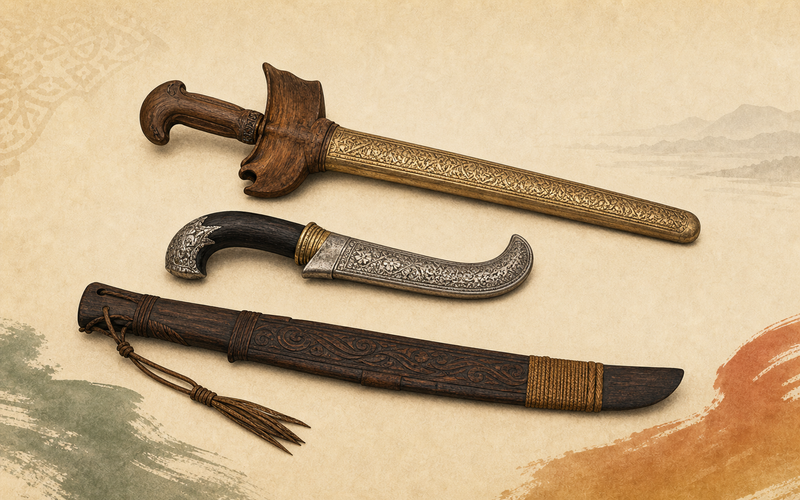
Traditional weapons in Indonesia cannot be understood only as instruments of combat. Across the archipelago, blades were shaped by court etiquette, hereditary prestige, craft lineages, and local systems of belief. Some remained closely tied to warfare or self-defense, but others gradually acquired roles in ceremony, diplomacy, and public dress. For museums, this matters because a weapon on display may also be a ritual object, a marker of office, or a family heirloom.
Among these objects, the keris is the most fully documented example of a weapon whose cultural life extends far beyond its blade. UNESCO describes the Indonesian kris, or keris, as a characteristic asymmetrical dagger that functions both as a weapon and as a spiritual object. Indonesian cultural authorities likewise present it as a work of art and a cultural emblem. This article therefore uses the keris as the central case study while also situating it within the broader world of Indonesian traditional weapons.
From Weapon to Heirloom
The history of Indonesian bladed weapons is diverse, and not every region developed the same ceremonial vocabulary. Aceh is associated with the rencong, Sulawesi with the badik, West Java with the kujang, and Borneo with the mandau. These objects belong to different historical settings and communities. A careful museum approach should therefore avoid collapsing them into a single narrative. What can be said with confidence is that many traditional weapons in Indonesia carried meanings beyond immediate use in battle.
The keris offers the clearest evidence of this shift. The Indonesian Ministry of Culture notes that its function changed over time: from weapon, to sacred heirloom, to family symbol, sign of service, sign of rank or office, and finally an admired art object. That long transformation explains why a keris may appear in a museum case not as a relic of violence but as an object embedded in social memory. Its value lies in both craftsmanship and the relationships it expresses between ancestors, households, and institutions.
The Keris as a Spiritual Object
UNESCO's description is unusually direct in identifying the keris as both practical and spiritual. The organization states that the object is often understood to possess magical powers, and it highlights the aesthetic vocabulary used to evaluate a blade, including its form, surface patterning, and attributed origin. Such language tells us that the keris is not judged only by sharpness or technical finish. It is also interpreted through inherited systems of symbolism, connoisseurship, and belief.
This spiritual dimension helps explain why keris collections are often treated with a form of respect not normally extended to ordinary arms. In many Indonesian contexts, a keris may be discussed as pusaka, an heirloom with moral and genealogical weight. That does not mean every blade was sacred in the same way, nor that all communities held identical beliefs. It does mean that the boundary between weapon, artwork, and charged cultural object was historically permeable. For curators, this is the key distinction: the keris belongs to a living interpretive tradition, not only to a military typology.
Court Dress, Ceremonies, and Rank
Ceremonial roles become especially visible when the keris is considered as part of dress. Indonesian cultural documentation notes that keris were worn as elements of formal attire in places such as Riau, Bugis regions, Java, and Bali. Placement on the body could vary by region and circumstance. In Java and Sunda, for example, the ministry notes a distinction between how the weapon was positioned in times of peace and in times of war. Such details show that wearing the blade communicated social information rather than merely preparing the bearer for combat.
The keris also functioned as an emblem of hierarchy. Rijksmuseum records identify one luxurious example as a gift presented to Governor-General J. C. Baud in 1834 during a diplomatic inspection tour, describing the kris as an appropriate gift because it symbolized power and protected its wearer from evil. Another Rijksmuseum object is interpreted as belonging to a high-ranking dignitary because of its expensive materials and finish. These museum records support a larger point: in courtly and political settings, a weapon could serve as regalia, diplomatic language, and visible rank.
Regional Variation Beyond Java
The ceremonial life of Indonesian weapons did not stop at the Javanese court. The Ministry of Culture describes the spread of keris culture across a broad area of the archipelago and the wider Malay world, including Sumatra, Sulawesi, Bali, and other regions. Handles, sheaths, and decorative motifs vary from place to place, and those variations often reflect local aesthetics and social worlds. A Sulawesi hilt shaped with bird imagery, for instance, does not carry exactly the same cultural associations as a Javanese court hilt.
Museum collections also make this variation visible outside Java. The Metropolitan Museum of Art's Balinese kris, for example, is cataloged as a regional object rather than a generic Indonesian dagger, reminding readers that ornament, hilt form, and local court or temple settings can make a keris legible as Balinese as well as Indonesian.
That regional variation is important for the article's broader theme. "Traditional Indonesian weapons" is a useful umbrella term, but it should not erase local distinctions. Some weapons remained more closely identified with martial reputation, while others entered court ceremony, hereditary display, or ritualized dress more fully. The keris stands at the center of this discussion because its ceremonial roles are well documented, but it also points to a wider Indonesian pattern in which weapons could become carriers of identity, legitimacy, and ancestral continuity.
For a Toba Batak case, explore Piso Gaja Dompak and the Sisingamangaraja heirloom tradition, where accounts of succession connect a named blade with royal authority.
Why Craftsmanship Matters
Weapons become ceremonial objects partly through the labor invested in making them. UNESCO emphasizes the keris blade's form, the decorative metal pattern known as pamor, and the importance of identifying age and origin. Indonesian cultural authorities similarly stress the skill of the empu, the specialist maker, and the technical complexity of forging and assembling the object. These features matter because ceremonial authority is often materialized through craft. A blade that signifies status or sacred value must look and feel unlike an ordinary utilitarian tool.
Material richness could reinforce this effect. Museum collections preserve keris with gold, silver, horn, ivory, diamonds, or finely carved wood. Yet elaborate materials alone do not create ceremonial significance. What matters is the joining of materials, inherited design conventions, and recognized expertise. In this sense, the ceremonial role of a weapon does not begin after manufacture; it begins in the workshop, where technical knowledge and cultural codes are fused into a single object. The maker is therefore as important to the story as the eventual owner.
Preserving Knowledge in the Present
Modern safeguarding efforts show that Indonesian society continues to treat keris culture as knowledge worth transmitting, not merely as antiques worth storing. UNESCO's accredited profile for the Sekretariat Nasional Perkerisan Indonesia reports work in identification, documentation, research, preservation, education, and revitalization. It also notes a certification scheme recognizing multiple aspects of keris expertise, from iron work to decorative arts. This is a significant point for museums: conservation of the object alone is not enough if the associated skills disappear.
The present-day museum role therefore extends beyond collecting finished blades. Exhibitions, workshops, and educational programs can present traditional weapons as nodes in a larger cultural system that includes smiths, wearers, rituals, family histories, and regional identities. When handled this way, a keris is not reduced to an exotic blade. It becomes evidence of how Indonesian communities transformed instruments of force into carriers of authority, memory, artistry, and belief.
Related Reading
For the craft side of the keris, see Indonesian keris craftsmanship. For a broader historical overview, read Indonesian weapons through history, and for a focused object interpretation see the keris as weapon, heirloom, and sacred object.
Conclusion
Traditional Indonesian weapons occupy a space where material culture, social order, and symbolic meaning meet. The keris demonstrates this especially well: once a weapon, it also became heirloom, attire, diplomatic gift, sign of office, and spiritual object. That layered history is why museums should resist reading such objects only through the lens of warfare.
To study ceremonial weapons in Indonesia is to study the cultural lives attached to them. Blades were forged, worn, exchanged, inherited, and interpreted within systems of rank, belief, and craft. Seen in that light, the ceremonial role of the weapon is not secondary to its history. It is one of the main reasons the object still matters.