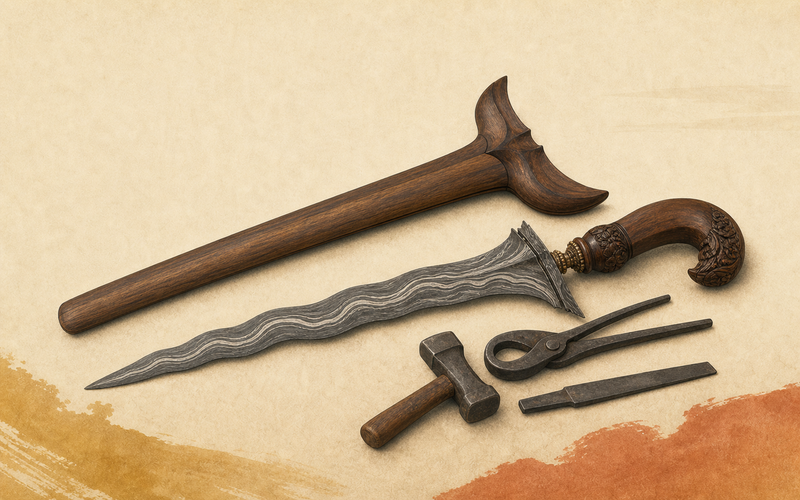
The Indonesian keris is one of Southeast Asia's most distinctive blades. It is usually recognized by its asymmetrical form, carefully fitted hilt and sheath, and, in many examples, a patterned blade surface known as pamor. Yet keris craftsmanship is not only a question of metal technique. It also belongs to the history of courts, households, heirlooms, ceremonial dress, and regional identity.
For readers searching for the evolution of keris craftsmanship, the most useful starting point is that the object changed in social role as well as in form. Indonesian cultural authorities describe a long movement from weapon to sacred heirloom, family symbol, sign of office, and art object. UNESCO likewise recognizes the Indonesian kris as intangible cultural heritage, emphasizing the knowledge and traditions surrounding it. A museum article should therefore explain how making, wearing, caring for, and interpreting the keris all belong to its craft history.
Blade, Hilt, and Sheath
A keris is a composite object. The blade often receives the most attention, but the hilt and sheath also communicate region, status, and aesthetic preference. A museum label that describes only "a wavy dagger" misses much of the object's cultural life. Some blades are straight, some are waved, and the number and form of curves should not be turned into universal symbolism without reliable local interpretation.
The blade's asymmetry is central to identification. Its base, profile, and surface pattern help specialists discuss age, region, and style. The hilt may be carved from wood, horn, ivory, metal, or other materials depending on period, patronage, and locality. The sheath protects the blade but also makes the keris visible as dress, regalia, or display.
Forging and Pamor
Keris craftsmanship is often associated with pattern-welded metal. Pamor refers to the visible patterning created through the interaction of metals and forging technique. These patterns can be admired for beauty, technical difficulty, and inherited interpretation. Some traditions associate particular pamor patterns with desired qualities, but those meanings are not identical everywhere and should not be presented as fixed scientific facts.
The specialist maker, often called an empu, occupies a respected place in keris culture. Technical skill matters: heating, folding, shaping, hardening, polishing, and fitting require knowledge accumulated through practice. But craft authority is also cultural. The maker works within expectations about proportion, suitability, patronage, and the intended life of the blade.
From Weapon to Heirloom
The keris had a martial role, but its history cannot be reduced to combat. The Directorate of Heritage and Cultural Diplomacy describes the keris as changing function over time from weapon to heirloom, family symbol, sign of service or rank, and art object. This transformation is one reason the keris appears so often in museum collections. It is evidence of social memory as much as military technology.
As an heirloom, or pusaka, a keris may carry genealogical and moral weight. Families and courts may preserve blades because of their association with ancestors, office, or important events. This does not mean every keris has the same sacred status. It means that the object's meaning depends on ownership history, regional practice, and the interpretive community around it.
Courts, Diplomacy, and Status
Courtly settings helped shape keris refinement. In Java, Bali, and parts of the wider Malay world, the keris could be worn as part of formal dress and connected to rank or ceremony. Rijksmuseum records for a kris presented to Governor-General J. C. Baud in 1834 describe it as a diplomatic gift associated with power and protection. Such examples show how a blade could function as political language.
This connection to status also affected craftsmanship. Materials, surface finish, hilt carving, sheath form, and metal fittings could all signal prestige. A richly mounted keris should not be read simply as decoration. It may mark the owner's position, the importance of an occasion, or the desire to make authority visible through a portable object.
Regional Styles and Careful Interpretation
There is no single Indonesian keris style. Javanese, Balinese, Madurese, Bugis, Malay, and other traditions developed different preferences in blade form, hilt shape, sheath design, and modes of use. A museum should identify region whenever possible rather than treating the keris as a generic national symbol. Regional specificity respects the communities that produced and interpreted the object.
Care is part of the craft tradition. Cleaning, oiling, storing, and periodically examining a keris can be practical, aesthetic, and ritualized depending on context. Responsible writing should avoid claiming that every owner performs the same rites or believes the same things. The safer point is that keris preservation has historically included knowledge beyond ordinary metal maintenance.
Image interpretation should be equally careful. If an article uses a keris photograph, useful alt text should identify the object without overclaiming its ritual status, for example: "Indonesian keris with patterned blade, carved hilt, and wooden sheath." Claims about sacred power, date, or region should be added only when the collection record supports them.
Keris Craftsmanship Today
Keris making continues through artisans, collectors, educators, cultural organizations, and safeguarding programs. UNESCO's profile of the Sekretariat Nasional Perkerisan Indonesia notes work in identification, documentation, research, education, preservation, and revitalization. This is important because intangible heritage depends on people, not only on surviving objects.
Modern keris production can include both traditional and contemporary choices. Some makers reproduce older styles, while others adapt forms for new patrons. The challenge is not to freeze craft in one imagined past, but to preserve the knowledge needed to understand quality, context, and meaning. Readers interested in the ceremonial side of these objects can continue with traditional Indonesian weapons and their ceremonial roles and the keris as weapon, heirloom, and sacred object.
Conclusion
The evolution of Indonesian keris craftsmanship is a story of metal, memory, and meaning. Forging technique, pamor, hilt carving, sheath making, and regional style all matter, but they become historically powerful because the keris entered systems of ceremony, inheritance, diplomacy, and identity.
For museums, the keris is strongest when interpreted as both object and knowledge tradition. It is a blade, but also a record of skilled hands, social rank, family memory, and cultural interpretation. To understand keris craftsmanship is to see how Indonesian material culture can turn metal into heritage.