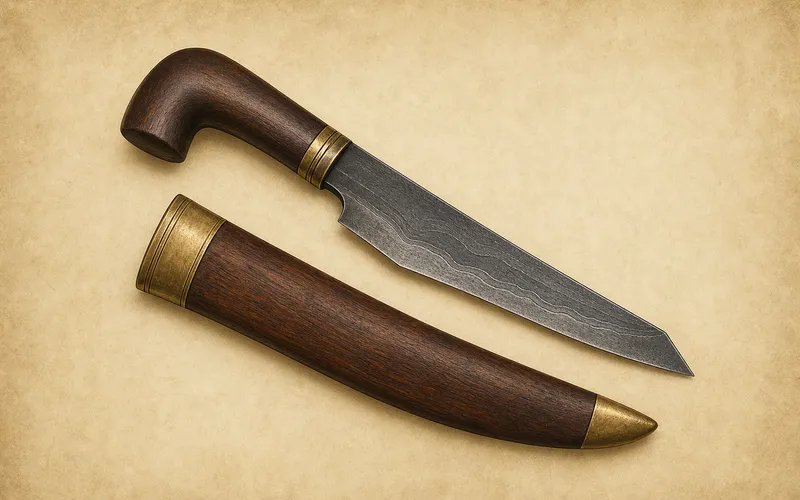
A badik is a short knife or dagger strongly associated with Bugis and Makassar communities in South Sulawesi. Its compact blade, fitted hilt, and sheath make it a portable personal object, with histories of practical use, self-protection, inheritance, and ceremonial dress. It is a distinct blade tradition, not simply a small keris.
Bugis badik and Makassar badik are useful starting terms, but neither names one uniform design. Blade profile, metal patterning, hilt, and sheath should be described for the particular example. Social meanings also depend on its owner, place, and occasion.
Bugis and Makassar Badik: Blade, Hilt and Sheath
The national heritage entry for Kawali Gecong describes a Bugis tradition in Bone. It identifies a flat blade widening through the middle and tapering to a point, a pangulu or hilt, and a wanua or sheath. These details describe that named tradition rather than every South Sulawesi badik. National heritage record: Kawali Gecong.
Makassar forms have their own regional distinctions. A 2019 study at Universitas Negeri Makassar identifies six laca’, or form conventions, as markers of regional identity. It supports examining profile and attribution rather than dividing all examples into one “Bugis shape” and one “Makassar shape.” Lanta, Syahrir and Cahyadi: Laca’ Badik Makassar.
Look at the blade together with its fittings: the hilt is the grip, while the sheath protects the edge and enables carrying. Materials, fit, wear, and ornament are observable evidence. A claim about protective power or an inherited owner's status requires a recorded local interpretation or provenance; it cannot be read from decoration alone.
Craft, Pamor, and Material Presence
Like several other Indonesian blades, the badik is sometimes discussed in relation to pamor, the visible patterning associated with forged metal. In museum language, pamor can be described materially as a patterned surface created through metalworking. In cultural language, it may also be linked with ideas of character, fortune, or suitability between object and owner. Both registers should be handled carefully: the pattern is visible, while its meanings depend on local interpretation.
The badik's small scale makes craftsmanship especially important. A slight change in blade thickness, handle angle, or sheath fit can alter how the object sits on the body and how quickly it can be drawn. Ornament is not merely decoration. A fine handle, polished sheath, or carefully finished blade could mark care, wealth, rank, or inherited value. A plain badik could be just as meaningful in a family setting, especially if its story was remembered.
Siri and Situated Social Meanings
South Sulawesi's cultural office connects carrying a badik with siri, understood in its explanation as maintaining personal and family dignity. This is a regional interpretation, not evidence that every Bugis or Makassar person carries a blade or shares an identical code of conduct. Provincial cultural office: Badik.
Interpretation should distinguish a community ideal from a description of every individual. A family heirloom may preserve a remembered owner or maker; ceremonial wearing may place the object within formal dress. Neither value nor virtue can be inferred simply from possessing a weapon.
Everyday Tool, Heirloom, and Ceremonial Sign
The national heritage account of Kawali Gecong records protective beliefs and an expression linking possession of a kawali with Bugis identity in Bone. This documents a particular cultural account, not a universal rule for every Bugis or Makassar person and not proof of supernatural power. National heritage record: Kawali Gecong.
In a family collection or ceremonial setting, provenance matters as much as appearance. An inherited blade and one acquired for formal dress may look similar while having different histories. Record the owner, occasion, and local explanation before describing a specific badik as an heirloom or ritual object.
The national heritage register lists South Sulawesi's Badik under traditional craft skills in its 2014 designation. This records recognition of a making tradition, not authentication or dating of every surviving blade. National heritage register.
Difference From the Keris
The badik is sometimes compared with the keris because both are culturally important blades in the Indonesian archipelago. The comparison is helpful only up to a point. UNESCO's keris documentation is unusually rich, which makes it useful for contrast, but it should not become a template imposed on every Indonesian blade. The keris is famous for its distinctive base construction, layered symbolism, and widespread courtly associations across Java, Bali, the Malay world, and other regions. The badik has its own South Sulawesi center of gravity and should not be treated as a smaller keris.
Form helps make the distinction clear. Many badik are compact, asymmetric knives or daggers with sheaths designed for waist carrying. They may be elegant, but their social force often lies in directness: a close blade, a known owner, a visible sign of readiness. By presenting the badik on its own terms, museums can avoid flattening Indonesian blade traditions into one familiar category.
UNESCO describes the keris as an asymmetrical dagger that may have a straight or wavy blade. Waviness alone is therefore not a reliable way to separate a keris from a badik: examine the base, overall construction, and documented local name. UNESCO: Indonesian Kris.
Museums and Responsible Interpretation
A museum label for a badik should begin with verifiable information: place, material, dimensions, date if known, maker if recorded, and collection history. From there, interpretation can open toward cultural meaning. The badik may be discussed as a Bugis and Makassar object connected with honor, masculinity, craft, and heirloom memory, but these meanings should be presented as historically and socially situated rather than universal.
It is also important not to over-romanticize the blade. The badik has a history that includes practical use and the possibility of violence. But its museum value is not limited to that history. It shows how a community can give a portable object ethical, emotional, and aesthetic force. It asks viewers to look at a blade not only as sharpened metal, but as a sign carried through relationships.
Related Reading
For the broader cluster, see Weapons and Regalia. For comparison with other Indonesian blades, read traditional weapons across the archipelago, the keris as weapon, heirloom, and sacred object, and the Dayak mandau.
For regional context beyond weapons, explore Bugis maritime culture.
Conclusion
The Bugis and Makassar badik is a concise object: blade, handle, sheath, and the space it occupies at the waist. Yet within that small form gather stories of forging, family, dignity, and regional belonging. Its power in a museum lies in that density. The badik teaches that Indonesian weapons are not only instruments of conflict. They are also crafted witnesses to how societies have shaped courage, restraint, and identity into material form.